
Ahh…the dreams of youth; so full of hope for the future. This holiday season, we invite you to view the Eloqua Holiday Cinema eMovie special release, ‘Career Day’ for a glimpse into youthful aspirations.
This eMovie was inspired by a scene from the award winning romantic comedy, Annie Hall, which was directed by Woody Allen in 1977.
Watch ‘Career Day’ by clicking the player below.
Happy Holidays from all of your friends at Eloqua!
Monday, December 21, 2009


Thursday, December 17, 2009
Simple Metrics and the Business Case for Marketing Automation
There has been a lot of great discussion lately about the business case for marketing automation. For obvious reasons, I'm excited to see the discussion, but it often takes an interesting turn. The way in which people often attempt to measure it is in either efficiency gains, or revenue gains - when compared with a manual process for marketing in the same way.
This is the comparison I see a challenge with, and viewed in that light, it will be hard to see the level of value that is being seen today by the best marketers.
 If you look at what marketing automation does in terms of business transformation, it is insufficient to characterize it in terms of simply just an efficiency gain, or a revenue gain. It changes the way that we, as B2B marketing organizations, are able to interact with prospects, and opens up new avenues of prospect understanding and prospect communication that simply would not have been viable without marketing automation.
A comparison is the transition from film to digital cameras. If you look at what is possible with film cameras, in terms of photo sharing, digital editing, virtually unlimited photo storage, and the social media use of photos, it is clear that digital cameras present an entirely new way of interacting with images. If contemplated from a framework of film photography, you might look at something like sharing a photo to Facebook and think of digital cameras as offering an efficiency gain; it’s possible with film, you just snap the photo, develop it, scan it, save it to a file, and then upload it. Much less “efficient” but still possible.
However, this misses the point. These things are not simply spectrums of efficiency or revenue, as there is a certain point at which the task would simply not be done.
If you look at the business process that B2B marketers using marketing automation are working to enable, it has a similar challenge. A simple way of looking at it is that we are seeking to:
a) Understand prospective buyers through reading their digital body language
b) Communicate with them accordingly, either through lead nurturing when they are early in their buying process, or through sales engagement if they are later in their buying process
The challenge with making a direct comparison between marketing as enabled and automated with today’s marketing automation software platforms, and marketing without using automation is that the level of buyer understanding and engagement being sought is simply not attainable without automation in any practical way.
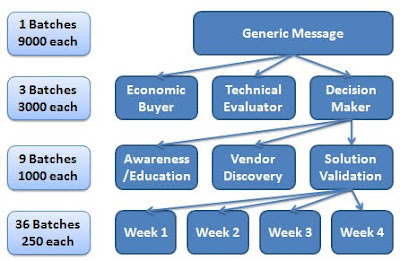 To put the marketing situation in context, using marketing automation, we are attempting to deliver the right message to the right buyer at the right time. This means that we might use digital body language to understand the buyer’s role in the buying process (technical evaluator vs economic buyer), we might seek to understand where they are in their buying cycle (awareness/education vs vendor discovery vs solution validation), and we might attempt to time a message a week after they last engaged with us in order to remain top of mind.
Building this with outbound, batch and blast marketing solutions leads to a fundamental problem. Even with this simple version of buyer understanding and message personalization, the level of personalization required quickly moves you from a single communication per month, of perhaps 9000 recipients, to 36 individual communications, each only going to 250 people. On top of this, the lack of built-in awareness of buyers’ digital body language would mean that you had 36 individual segments to select, based on an off-line analysis of the prospect’s behavior.
This leaves us in a similar comparison to the digital vs film photography example. Much as sharing photos on Facebook is theoretically possible using film photography, but in practical terms virtually impossible, marketing in a way that understands and responds to buyers’ digital body language is, in any practical terms, impossible without marketing automation software. You must compare one overall approach with another, and understand it in aggregate.
So, when compared in aggregate, it is tempting to come back to the argument that it only makes sense in terms of a revenue gain or a cost decrease. This is not altogether false, but must be understood in context of your overall market. As it is not possible to truly understand and respond to the unique buying process of each of your buyers without a marketing automation solution, the comparison must now be understood in the context of the competitive landscape. If your competition is understanding and engaging the prospective buyers in your industry based on their individual buying processes, while you are not, they will have access to revenue that you simply will not have access to.
Framing the argument in terms of marketing automation allowing an increase in the efficiency, or the output of an existing revenue generating process is ignoring the fact that marketing automation allows a fundamental, and much needed, change to the revenue generation process itself.
This is the comparison I see a challenge with, and viewed in that light, it will be hard to see the level of value that is being seen today by the best marketers.
 If you look at what marketing automation does in terms of business transformation, it is insufficient to characterize it in terms of simply just an efficiency gain, or a revenue gain. It changes the way that we, as B2B marketing organizations, are able to interact with prospects, and opens up new avenues of prospect understanding and prospect communication that simply would not have been viable without marketing automation.
A comparison is the transition from film to digital cameras. If you look at what is possible with film cameras, in terms of photo sharing, digital editing, virtually unlimited photo storage, and the social media use of photos, it is clear that digital cameras present an entirely new way of interacting with images. If contemplated from a framework of film photography, you might look at something like sharing a photo to Facebook and think of digital cameras as offering an efficiency gain; it’s possible with film, you just snap the photo, develop it, scan it, save it to a file, and then upload it. Much less “efficient” but still possible.
However, this misses the point. These things are not simply spectrums of efficiency or revenue, as there is a certain point at which the task would simply not be done.
If you look at the business process that B2B marketers using marketing automation are working to enable, it has a similar challenge. A simple way of looking at it is that we are seeking to:
a) Understand prospective buyers through reading their digital body language
b) Communicate with them accordingly, either through lead nurturing when they are early in their buying process, or through sales engagement if they are later in their buying process
The challenge with making a direct comparison between marketing as enabled and automated with today’s marketing automation software platforms, and marketing without using automation is that the level of buyer understanding and engagement being sought is simply not attainable without automation in any practical way.
 To put the marketing situation in context, using marketing automation, we are attempting to deliver the right message to the right buyer at the right time. This means that we might use digital body language to understand the buyer’s role in the buying process (technical evaluator vs economic buyer), we might seek to understand where they are in their buying cycle (awareness/education vs vendor discovery vs solution validation), and we might attempt to time a message a week after they last engaged with us in order to remain top of mind.
Building this with outbound, batch and blast marketing solutions leads to a fundamental problem. Even with this simple version of buyer understanding and message personalization, the level of personalization required quickly moves you from a single communication per month, of perhaps 9000 recipients, to 36 individual communications, each only going to 250 people. On top of this, the lack of built-in awareness of buyers’ digital body language would mean that you had 36 individual segments to select, based on an off-line analysis of the prospect’s behavior.
This leaves us in a similar comparison to the digital vs film photography example. Much as sharing photos on Facebook is theoretically possible using film photography, but in practical terms virtually impossible, marketing in a way that understands and responds to buyers’ digital body language is, in any practical terms, impossible without marketing automation software. You must compare one overall approach with another, and understand it in aggregate.
So, when compared in aggregate, it is tempting to come back to the argument that it only makes sense in terms of a revenue gain or a cost decrease. This is not altogether false, but must be understood in context of your overall market. As it is not possible to truly understand and respond to the unique buying process of each of your buyers without a marketing automation solution, the comparison must now be understood in the context of the competitive landscape. If your competition is understanding and engaging the prospective buyers in your industry based on their individual buying processes, while you are not, they will have access to revenue that you simply will not have access to.
Framing the argument in terms of marketing automation allowing an increase in the efficiency, or the output of an existing revenue generating process is ignoring the fact that marketing automation allows a fundamental, and much needed, change to the revenue generation process itself.
 |
 |
||||||
|
Tuesday, December 15, 2009
No such thing as a Neutral Outcome
There is no way to determine with 100% accuracy where an individual buyer is in their buying process. This leads to a difficult marketing conundrum when looking at targeting marketing efforts based on a best possible approximation of where that buyer is likely to be in his or her buying process; in a broad enough population, there will always be some response to a marketing campaign, regardless of what buyer stage it was targeted at.
For example, if an end of quarter campaign is targeted at those almost ready to purchase in order to spur the maximum amount of business for that quarter, it will have its maximum effect in buyers that are found to be nearly ready to purchase, and are in the solution validation phase. However, determining the stage a buyer is in is both inexact, and prone to change rapidly with time. Therefore, there will still be some response in buyers found to be in the earlier vendor discovery phase, and there may even be a small response among buyers who are at the earliest phases of education and awareness.
An argument is often made that this means that the best option is to have as broad a pattern of communication as you can. Even at the top of the funnel, you will be able to drive some revenue, albeit small, but with the cost of an email campaign being almost zero, the return is still there. As long as unsubscribe rates are not high, the downside is minimal, so the campaign is worthwhile.
 However, this argument assumes that anyone who does not respond to the offer is essentially a “neutral” outcome. They did not respond in a positive manner and move towards a purchase, they did not respond in a negative manner and unsubscribe, so their outcome must be neutral. This thinking is wrong, and leads to dangerous decision-making.
The outcome of the email campaign may indeed be neutral from the viewpoint of the marketer – no action was detected – but from the viewpoint of the prospect it was far from it. A non-response likely indicates that the prospect found nothing interesting about your message. This is a dangerous step towards that individual emotionally unsubscribing - reflexively ignoring your messages without looking to see if they are of interest.
Chances are, you only have a few opportunities to deliver an irrelevant message to a prospect before they begin to emotionally unsubscribe. Whereas they may not immediately, or ever, click on your unsubscribe link, you have essentially lost your ability to connect with that prospect. In today’s B2B marketing environment, no one can afford to lose the interest of their prospective buyers. The best way to maintain their interest is to ensure your communications are highly relevant to who they are, and more importantly to where they are in their own buying process.
One of the key goals of any marketing automation implementation is to do just that – to understand each individual’s behaviors and interests, and allow that person to be nurtured only with content of relevance to them. This approach tightens your segmentation focus to not just the demographics and firmographics of who the individual and their organization are, but also the psychographics of where they are in their buying process.
Only by eliminating the idea of a non-response being a “neutral” outcome can we understand the true cost of an irrelevant marketing communication.
*This post originally appeared as a guest post on Savvy B2B
For example, if an end of quarter campaign is targeted at those almost ready to purchase in order to spur the maximum amount of business for that quarter, it will have its maximum effect in buyers that are found to be nearly ready to purchase, and are in the solution validation phase. However, determining the stage a buyer is in is both inexact, and prone to change rapidly with time. Therefore, there will still be some response in buyers found to be in the earlier vendor discovery phase, and there may even be a small response among buyers who are at the earliest phases of education and awareness.
An argument is often made that this means that the best option is to have as broad a pattern of communication as you can. Even at the top of the funnel, you will be able to drive some revenue, albeit small, but with the cost of an email campaign being almost zero, the return is still there. As long as unsubscribe rates are not high, the downside is minimal, so the campaign is worthwhile.
 However, this argument assumes that anyone who does not respond to the offer is essentially a “neutral” outcome. They did not respond in a positive manner and move towards a purchase, they did not respond in a negative manner and unsubscribe, so their outcome must be neutral. This thinking is wrong, and leads to dangerous decision-making.
The outcome of the email campaign may indeed be neutral from the viewpoint of the marketer – no action was detected – but from the viewpoint of the prospect it was far from it. A non-response likely indicates that the prospect found nothing interesting about your message. This is a dangerous step towards that individual emotionally unsubscribing - reflexively ignoring your messages without looking to see if they are of interest.
Chances are, you only have a few opportunities to deliver an irrelevant message to a prospect before they begin to emotionally unsubscribe. Whereas they may not immediately, or ever, click on your unsubscribe link, you have essentially lost your ability to connect with that prospect. In today’s B2B marketing environment, no one can afford to lose the interest of their prospective buyers. The best way to maintain their interest is to ensure your communications are highly relevant to who they are, and more importantly to where they are in their own buying process.
One of the key goals of any marketing automation implementation is to do just that – to understand each individual’s behaviors and interests, and allow that person to be nurtured only with content of relevance to them. This approach tightens your segmentation focus to not just the demographics and firmographics of who the individual and their organization are, but also the psychographics of where they are in their buying process.
Only by eliminating the idea of a non-response being a “neutral” outcome can we understand the true cost of an irrelevant marketing communication.
*This post originally appeared as a guest post on Savvy B2B
|
|
|
||||||
|
Thursday, December 10, 2009
The Content Gap - Lead Nurturing and Content Creation
Many articles have been written about B2B marketing’s evolution towards a model where marketers act as publishers. As buyers are in control of their own buying process, we as marketers need to facilitate them through education, nurturing, and engagement. The best, if not only, way to do this is with great content that adds value, is thought-provoking, and captures the attention of the prospective buyer based on where he or she is in her buying process.
 Typically, buyers progress through stages of a buying process from Awareness, to Discovery, to Validation, and have unique content needs at each stage. Marketers who successfully cater their content to buyers at each of these stages do well in guiding and facilitating a buying process that results in revenue for their organization.
The start and end of the buying process are usually well covered by the traditional alignment of roles in an organization. Most marketers are quite experienced in creating the high level thought leadership whitepapers, educational sessions, and industry webinars that are ideal content for the Awareness stage of the funnel. Similarly, sales teams and product marketers are experienced at creating the “why buy us, why buy now” content that is appropriate for the Validation stage of the funnel, but a content gap is left in the middle of the funnel.
In the Discovery stage, prospective buyers have become aware of your solution category and the problems that you solve, and will likely have heard of your organization. Now, they are beginning to formulate their plan for solving the business pain that you solve, discovering vendors who they should investigate more deeply, and scoping the breadth and depth of the initiative in question. It is in this stage that “best practice” content is often most useful.
Depending on your industry and solution, this usually means content and writing that comes from your services team, subject matter experts, product consultants, designers, specialists, or engineers. These are the people who have the knowledge, expertise, and passion to write about what solutions like yours can accomplish, what the challenges and considerations are, and what others in the industry are doing. This is non-salesy content, but it is a level more detailed than the high level thought leadership that is appropriate at the Awareness stage.
The challenge is that these subject matter experts are not marketers, writers, or sales people. Their objectives, motivations, and compensation plans are not generally aligned with generating revenue, moving leads through a buying funnel, or creating great content that is appropriate for the middle of the funnel. Unless addressed, this can leave a critical content gap in the middle of the buying funnel, and lead to an awkward transition as buyers move from high level thought leadership content to much more tactical sales content without the educational transition of content in the Discovery stage.
Successful marketing organizations recognize this content gap, and find ways to motivate, compensate, and encourage the creation of educational, Discovery stage content by subject matter experts, but it can be a difficult process.
Has your organization identified a content gap? How have you dealt with the challenges it presented?
 Typically, buyers progress through stages of a buying process from Awareness, to Discovery, to Validation, and have unique content needs at each stage. Marketers who successfully cater their content to buyers at each of these stages do well in guiding and facilitating a buying process that results in revenue for their organization.
The start and end of the buying process are usually well covered by the traditional alignment of roles in an organization. Most marketers are quite experienced in creating the high level thought leadership whitepapers, educational sessions, and industry webinars that are ideal content for the Awareness stage of the funnel. Similarly, sales teams and product marketers are experienced at creating the “why buy us, why buy now” content that is appropriate for the Validation stage of the funnel, but a content gap is left in the middle of the funnel.
In the Discovery stage, prospective buyers have become aware of your solution category and the problems that you solve, and will likely have heard of your organization. Now, they are beginning to formulate their plan for solving the business pain that you solve, discovering vendors who they should investigate more deeply, and scoping the breadth and depth of the initiative in question. It is in this stage that “best practice” content is often most useful.
Depending on your industry and solution, this usually means content and writing that comes from your services team, subject matter experts, product consultants, designers, specialists, or engineers. These are the people who have the knowledge, expertise, and passion to write about what solutions like yours can accomplish, what the challenges and considerations are, and what others in the industry are doing. This is non-salesy content, but it is a level more detailed than the high level thought leadership that is appropriate at the Awareness stage.
The challenge is that these subject matter experts are not marketers, writers, or sales people. Their objectives, motivations, and compensation plans are not generally aligned with generating revenue, moving leads through a buying funnel, or creating great content that is appropriate for the middle of the funnel. Unless addressed, this can leave a critical content gap in the middle of the buying funnel, and lead to an awkward transition as buyers move from high level thought leadership content to much more tactical sales content without the educational transition of content in the Discovery stage.
Successful marketing organizations recognize this content gap, and find ways to motivate, compensate, and encourage the creation of educational, Discovery stage content by subject matter experts, but it can be a difficult process.
Has your organization identified a content gap? How have you dealt with the challenges it presented?
|
|
|
||||||
|
Tuesday, December 8, 2009
Publishing vs Social Media; a Difference of Filters
I’m sure we’ve all been in conversations around why social media is important to us as B2B marketers. Many of the discussions of its importance talk about joining the conversation, building a dialog, and engaging customers. I definitely agree that those are important, and that social media in general is of significant importance, but I want to frame the issue in a different light.
 To understand what social media means in terms of marketing, we need to go all the way back to 1450. Johanes Guttenberg invented movable type, and with it, gave society the ability to mass produce information. With a bit of setup cost, a vast number of books could be produced, and that setup cost spread across all the books produced, making them economical enough for the average person to buy.
This, however, meant one important thing; the publisher was taking all the risk. If the books didn’t sell, he incurred all the cost, and received none of the revenue. This meant that the publisher had to pick good quality information to share – it was an “economic filter” on the quality of information. That same model transferred over to all other forms of mass media; television, music, movies, etc. The publisher of information had to bear the burden of producing information of good enough quality to generate a good sized audience, or they would not remain in business.
It was on this “economic filter” that modern marketing was built; by paying the publishers of media to allow us to “bypass” this filter, and insert our message in their publication, marketers were able to “buy” access to an audience. Whether in television, print, radio, or online media, the concept was essentially the same.
However, this has all changed with the advent of social media. The cost to publish a message and have it accessible to the entire world has fallen to zero. This means that the economic filter of quality, upon which both the entire publishing industry and the discipline of marketing has been based, is no longer a necessary construct.
What replaces it is the concept of a social filter. Information is deemed “good” if many people find it interesting. The original social search engine, of course, is Google. A link to a piece of content is essentially a social “vote” on that piece of content’s quality, and links are predominantly what Google, and all other major search engines use to rank content. As things progress, this trend will only accelerate as the search engines are leveraging the insights from social media in order to guide the ranking of content, and the social media sites themselves are using lists and groups to guide their understanding of social influence by topic area.
As access to information moves from the “economic filter” driven model of the publishing industry to the “social filter” driven model of tomorrow, we as marketers need to adapt how we communicate with buyers and how we learn who is interested. Rather than access content from specific sources on general topics, as they did in the publisher model, in a social model, audiences “discover” information based on the likes and dislikes of the peer group they respect and listen to.
As marketers, we need to ensure that great content is inserted into this conversation, and the influencers in the market spaces we are interested in are carefully nurtured and listened to. It is through them, and through the dynamics of social filters, that our messages will be discovered by the broader audience we hope to influence.
This is the fundamental reason why we need to do all those things that are talked about as the key activities in social media. Joining the conversation, building a dialog, and engaging customers, are all ways to influence the influencers in our market spaces and have our messages discovered. The investments we would have made in buying our way through the economic filters of the publishing industry we now need to make in influencing our way through the social filters of today's world. It is a different mindset, and different investments, but is as important as the advertising dollar investments we made over the last few decades.
 To understand what social media means in terms of marketing, we need to go all the way back to 1450. Johanes Guttenberg invented movable type, and with it, gave society the ability to mass produce information. With a bit of setup cost, a vast number of books could be produced, and that setup cost spread across all the books produced, making them economical enough for the average person to buy.
This, however, meant one important thing; the publisher was taking all the risk. If the books didn’t sell, he incurred all the cost, and received none of the revenue. This meant that the publisher had to pick good quality information to share – it was an “economic filter” on the quality of information. That same model transferred over to all other forms of mass media; television, music, movies, etc. The publisher of information had to bear the burden of producing information of good enough quality to generate a good sized audience, or they would not remain in business.
It was on this “economic filter” that modern marketing was built; by paying the publishers of media to allow us to “bypass” this filter, and insert our message in their publication, marketers were able to “buy” access to an audience. Whether in television, print, radio, or online media, the concept was essentially the same.
However, this has all changed with the advent of social media. The cost to publish a message and have it accessible to the entire world has fallen to zero. This means that the economic filter of quality, upon which both the entire publishing industry and the discipline of marketing has been based, is no longer a necessary construct.
What replaces it is the concept of a social filter. Information is deemed “good” if many people find it interesting. The original social search engine, of course, is Google. A link to a piece of content is essentially a social “vote” on that piece of content’s quality, and links are predominantly what Google, and all other major search engines use to rank content. As things progress, this trend will only accelerate as the search engines are leveraging the insights from social media in order to guide the ranking of content, and the social media sites themselves are using lists and groups to guide their understanding of social influence by topic area.
As access to information moves from the “economic filter” driven model of the publishing industry to the “social filter” driven model of tomorrow, we as marketers need to adapt how we communicate with buyers and how we learn who is interested. Rather than access content from specific sources on general topics, as they did in the publisher model, in a social model, audiences “discover” information based on the likes and dislikes of the peer group they respect and listen to.
As marketers, we need to ensure that great content is inserted into this conversation, and the influencers in the market spaces we are interested in are carefully nurtured and listened to. It is through them, and through the dynamics of social filters, that our messages will be discovered by the broader audience we hope to influence.
This is the fundamental reason why we need to do all those things that are talked about as the key activities in social media. Joining the conversation, building a dialog, and engaging customers, are all ways to influence the influencers in our market spaces and have our messages discovered. The investments we would have made in buying our way through the economic filters of the publishing industry we now need to make in influencing our way through the social filters of today's world. It is a different mindset, and different investments, but is as important as the advertising dollar investments we made over the last few decades.
|
|
|
||||||
|
Thursday, December 3, 2009
Evaluating Marketing Automation - System Performance and Usability
Evaluating the various claims in the marketing automation space is an interesting challenge. There are a variety of players, and many of the claims overlap quite a lot. It can be daunting to tell truth from fiction. I often get asked how one should independantly verify many of the claims, and I'm a big believer in the idea that the more educated a marketing automation buyer is, the better they do when they purchase a platform.
 In light of that, I wanted to provide a series of actual tests that you can do when evaluating marketing automation systems. Real data (like this CSV file of sample contacts for this exercise), things to look for, and expected results are provided.
One of the basic elements to look at is system performance. It can be tempted to think of system performance as a "hygiene" factor that is common across the industry, but it's worth taking a deeper look at. The reason that this is the case is that marketing is, somewhat surprisingly, a very high scale activity. Think about the numbers for a second:
- An email campaign is sent out to your database of 50,000 people
- 30% of those people open the email, many of them multiple times, leading to 20,000 unique opens
- 3% of the email recipients visit your website, along with another 2,000 anonymous visitors, each seeing on average just less than 3 pages, for a total of 10,000 page views
- Each person in your database is scored against their title, their industry, their email opens and clicks, and their web activity (5 criteria x 50,000 people)
- The score for each person is updated in your CRM system
Very quickly, we have generated 380,000 transactions on a single day, and that is with a medium-sized database of 50,000 contacts only doing a very simple task. As soon as you begin to use your marketing automation platform more heavily, these numbers can grow quickly. If you don’t adequately assess the performance of the marketing automation platform you select, you may end up with slow performance affecting the experience of your marketing users
But how can this be assessed without a deep technical dive into each marketing automation platform? Quite simply, in fact.
In order to assess system performance, you need to see the system actually operating under conditions that you are interested in. Claims, quotes, and architecture diagrams will never compare with actually seeing the system do what you need it to do.
Here is a simple test that you can ask any of the marketing automation software vendors you are interested in evaluating to try during your demo with them.
 Here is a link to a sample contact data file of 50,000 randomly generated contacts. Each one has basic information you would expect; name, address, company, email address. There are some duplicates in here, leaving just under 45,000 unique names. It’s not a huge file (only 5MB), so it should be easily accessible by anyone with Internet access.
When you are reviewing a demo of a marketing automation provider, give them the file (or the link) and ask them to do the following:
1. Upload the file to the marketing automation database (should take less than a few minutes, and you should be able to continue with the demo while it is being uploaded)
2. Ensure that the duplicates in the data are automatically handled (look for Claudia.Patterson@RainGolfEquipment.co.com as an example) to see if her data is clean (there are two records for her, which should be merged seamlessly)
3. Run a report that shows the breakdown in Job Titles within that set of data (to give you a sense of the platform’s ability to run rules against the data without impacting performance)
4. Export the full list again as a .csv file to test the system performance when doing a bulk export.
5. Delete the data that had been uploaded to ensure good performance when deleting in bulk
These 5 steps will tell you a lot about the performance of the marketing automation platform you are about to select. Things to look for are the following:
- How long does it take to upload the data?
- Is the platform usable while the upload is taking place?
- Are duplicates handled smoothly and accurately?
- Can the data be explored and reported on while in the marketing automation platform?
- Can data and reports be exported quickly and without causing platform performance issues?
- Can unneeded data be deleted in bulk, allowing you to keep your marketing database clean?
System performance is one of the most critical aspects of usability, and is very much worth evaluating. If you are considering an investment, this quick test is an easy one to perform and will give you very rich insights into whether the platform you are about to select will meet your needs.
 In light of that, I wanted to provide a series of actual tests that you can do when evaluating marketing automation systems. Real data (like this CSV file of sample contacts for this exercise), things to look for, and expected results are provided.
One of the basic elements to look at is system performance. It can be tempted to think of system performance as a "hygiene" factor that is common across the industry, but it's worth taking a deeper look at. The reason that this is the case is that marketing is, somewhat surprisingly, a very high scale activity. Think about the numbers for a second:
- An email campaign is sent out to your database of 50,000 people
- 30% of those people open the email, many of them multiple times, leading to 20,000 unique opens
- 3% of the email recipients visit your website, along with another 2,000 anonymous visitors, each seeing on average just less than 3 pages, for a total of 10,000 page views
- Each person in your database is scored against their title, their industry, their email opens and clicks, and their web activity (5 criteria x 50,000 people)
- The score for each person is updated in your CRM system
Very quickly, we have generated 380,000 transactions on a single day, and that is with a medium-sized database of 50,000 contacts only doing a very simple task. As soon as you begin to use your marketing automation platform more heavily, these numbers can grow quickly. If you don’t adequately assess the performance of the marketing automation platform you select, you may end up with slow performance affecting the experience of your marketing users
But how can this be assessed without a deep technical dive into each marketing automation platform? Quite simply, in fact.
In order to assess system performance, you need to see the system actually operating under conditions that you are interested in. Claims, quotes, and architecture diagrams will never compare with actually seeing the system do what you need it to do.
Here is a simple test that you can ask any of the marketing automation software vendors you are interested in evaluating to try during your demo with them.
Here is a link to a sample contact data file of 50,000 randomly generated contacts. Each one has basic information you would expect; name, address, company, email address. There are some duplicates in here, leaving just under 45,000 unique names. It’s not a huge file (only 5MB), so it should be easily accessible by anyone with Internet access.When you are reviewing a demo of a marketing automation provider, give them the file (or the link) and ask them to do the following:
1. Upload the file to the marketing automation database (should take less than a few minutes, and you should be able to continue with the demo while it is being uploaded)
2. Ensure that the duplicates in the data are automatically handled (look for Claudia.Patterson@RainGolfEquipment.co.com as an example) to see if her data is clean (there are two records for her, which should be merged seamlessly)
3. Run a report that shows the breakdown in Job Titles within that set of data (to give you a sense of the platform’s ability to run rules against the data without impacting performance)
4. Export the full list again as a .csv file to test the system performance when doing a bulk export.
5. Delete the data that had been uploaded to ensure good performance when deleting in bulk
These 5 steps will tell you a lot about the performance of the marketing automation platform you are about to select. Things to look for are the following:
- How long does it take to upload the data?
- Is the platform usable while the upload is taking place?
- Are duplicates handled smoothly and accurately?
- Can the data be explored and reported on while in the marketing automation platform?
- Can data and reports be exported quickly and without causing platform performance issues?
- Can unneeded data be deleted in bulk, allowing you to keep your marketing database clean?
System performance is one of the most critical aspects of usability, and is very much worth evaluating. If you are considering an investment, this quick test is an easy one to perform and will give you very rich insights into whether the platform you are about to select will meet your needs.
|
|
|
||||||
|
Tuesday, December 1, 2009
The Evolution of Social Influence
Increasingly, social media sites are investing in ways to list, rank, and categorize participants. Twitter’s new list feature is the most recent incarnation of this. The challenge that is being tackled is simple; individuals do not have the same influence on their peers in all categories. This is clear just by looking at our own personal lives; a person we might turn to for advice on audio visual equipment might not be the same person we’d get local restaurant recommendations from, and we might turn to a third friend for guidance on the best travel deals.
 Basic metrics like the number of “friends” or “followers” don’t allow that level of detail to be captured, as one person may be widely followed for his opinions on cars, but that should not necessarily grant him any extra credibility when he chooses to share an opinion on wines. Lists, however, begin to break down this influence by categories. If this person is listed by many of his followers in lists pertaining to cars (or related synonyms) and none related to wine, then his influence on car-related topics should be seen to be much higher than his influence on wine-related topics.
This becomes vital when we begin to use social criteria to govern search results. A link that is shared by 10 wine experts should receive a much higher social ranking than a link that is shared by many more people if those people do not have a social graph that shows that they are respected by their peers on wine-related topics.
The credibility and authority we granted to the major publishing institutions, based mainly on their overall audience size, is now being parceled out to an infinitely broader publishing audience. Whereas an advertisement in a major topical publication may have been the best way of reaching that audience historically, now that access is through social means. If the key influencers in your topic area see a piece of content or a viewpoint as being relevant and correct, it will become discoverable to those who are interested in that topic area within a much broader network.
As B2B marketers, this will have a profound effect on us in the coming years. If we want our audiences to discover us, either directly through search, or through a variety of Amazon-like recommendation means that are likely to appear in the coming few years, we need to ensure that the world sees us as credible experts in the field that we hope to influence. This effect will be relevant all the way through our buyers' entire buying process, as the information they need, and dicsover as buyers, will be presented to them based on their peers and influencers.
There is no easy way to “short-cut” this process. Instead, to be seen as an expert, and included in the various lists, groups, and categories that will be seen as defining this expertise by the search engines, we need to continue to create great content that is read, shared, and referenced. As we do that, we will begin to find ourselves listed as experts in the categories in question, and the social influence we garner will be reflected by the search results of tomorrow.
 Basic metrics like the number of “friends” or “followers” don’t allow that level of detail to be captured, as one person may be widely followed for his opinions on cars, but that should not necessarily grant him any extra credibility when he chooses to share an opinion on wines. Lists, however, begin to break down this influence by categories. If this person is listed by many of his followers in lists pertaining to cars (or related synonyms) and none related to wine, then his influence on car-related topics should be seen to be much higher than his influence on wine-related topics.
This becomes vital when we begin to use social criteria to govern search results. A link that is shared by 10 wine experts should receive a much higher social ranking than a link that is shared by many more people if those people do not have a social graph that shows that they are respected by their peers on wine-related topics.
The credibility and authority we granted to the major publishing institutions, based mainly on their overall audience size, is now being parceled out to an infinitely broader publishing audience. Whereas an advertisement in a major topical publication may have been the best way of reaching that audience historically, now that access is through social means. If the key influencers in your topic area see a piece of content or a viewpoint as being relevant and correct, it will become discoverable to those who are interested in that topic area within a much broader network.
As B2B marketers, this will have a profound effect on us in the coming years. If we want our audiences to discover us, either directly through search, or through a variety of Amazon-like recommendation means that are likely to appear in the coming few years, we need to ensure that the world sees us as credible experts in the field that we hope to influence. This effect will be relevant all the way through our buyers' entire buying process, as the information they need, and dicsover as buyers, will be presented to them based on their peers and influencers.
There is no easy way to “short-cut” this process. Instead, to be seen as an expert, and included in the various lists, groups, and categories that will be seen as defining this expertise by the search engines, we need to continue to create great content that is read, shared, and referenced. As we do that, we will begin to find ourselves listed as experts in the categories in question, and the social influence we garner will be reflected by the search results of tomorrow.
|
|
|
||||||
|
Subscribe to:
Posts (Atom)


