
Much of the conversation around how best to set up lead scoring tends to focus around the aspects of the buyer's digital body language that are most interesting. What whitepaper, excerpt, or download they last looked at, and what this means in terms of their propensity to purchase.
These are all great discussions to have, but there are eight critical questions that need to be contemplated and discussed in order to build a lead scoring algorithm that will truly work in a business environment:
1) What are Your Outputs?: are you using lead scoring to determine who to hand off to sales? what message to communicate to them? who to nurture further? which accounts to get deeper visibility into? all of the above? Understanding your lead scoring outputs first is key in understanding how you want to approach the scoring of leads.
2) How does Time affect your Scores?: it's necessary to think through how the relevance of your prospect actions, and hence their lead score, degrades over time. An action 6, 12, or 18 months ago will likely not have the same relevance as the same action last week. For scoring interest level, this time factor is crucial, whereas for scoring on buyer role, this may not change as rapidly over time.
3) What Dimensions are Critical?: In lead scoring, it is important to clearly define what the question is that you are asking, and to build your scoring algorithm to match that question. If multiple lead scoring dimensions are merged into one, you will likely run into a challenge. Two of the most commonly used scoring dimensions are who the prospect is (explicit data like title, industry, and revenues) and how interested the prospect is (implicit data like web interest, search, and downloads).
4) How do you Cap and Bucket Scores so they are manageable?: When building a lead scoring algorithm, there are often a few buckets of data that come into play. For example in scoring the lead explicitly (who they are), you may look at title, industry, and revenues to determine whether the individual is highly qualified. To do this, it is often best to cap the scores available for each individual bucket. For example, if you are looking at the title to find an executive responsible for content strategy, you may give 10 points for "VP", "Content", "Digital", "Media" or "Production". However, would you want to give 50 points for a "VP of Digital Content and Media Production". Likely not, so this is where caps are needed. 10 points for any of the key terms, up to a maximum of 20.
5) Are your Scores Loosely Mapped to the Ranks that Determine Follow-Up?: If you are going to teach sales to follow up with leads that are defined as "A leads", you need to build in the flexibility to slightly adjust the bar on what makes a lead an "A lead" over time, without retraining sales. The best way to do this is to have both a lead score (a number such as 0-100) and a lead rank (a letter or grade such as A, B, C). Mapping the lead score to the lead rank allows you to adjust your criteria while sales does not change their process.
6) Do you Allow Sales to Cherry-Pick More Leads?: In many environments, especially when lead scoring has been implemented and only good leads are passed to sales, the sales team will feel as though they need more leads. They will ask for the lead funnel to be opened up to them so that they can "Cherry Pick" leads that they deem to be good. Allowing sales to cherry pick has opportunities as well as significant risks, however, and should be discussed carefully upfront.
7) If Sales Does Not Act, do you Claw Back the Lead?: In an ideal world, sales follows up with all leads. However, this is not the reality that most organizations live in, so a process is needed for automatically clawing back the sales lead into marketing if it has not been followed up on in a short time period. Once the lead has been clawed back, it can be re-allocated to another sales person, re-entered into a nurture program, or passed to a partner channel.
8) Have You Provided Sales with Disposition and Nurture Options?: If leads are not being followed up on by sales, it is difficult to adjust your processes unless you know why. Providing sales with options for lead disposition, including automated nurture programs that will continue to educate the lead until it is again ready for sales, can provide both great insight into reasons for lead rejection and foundation for better nurturing of leads.
By thinking through these eight critical factors up front, your lead scoring process will avoid a number of challenges on its road to adoption and success, and will succeed in driving revenue for your organization.
Showing posts with label explicit scoring. Show all posts
Showing posts with label explicit scoring. Show all posts
Monday, June 1, 2009


Wednesday, March 25, 2009
Lead Scoring - Thinking of Outputs First
I was on a webinar with Todd Davison of BullDog solutions the other day, and he had a great way of showing the outputs of lead scoring that I wanted to share as it gives a great conceptual model for how to think about lead scoring and what to do with the scored leads.
 Todd used a 2x2 matrix to talk about lead scoring from the perspective of outputs. What you want to do with the leads once you have understood who they are.
For the leads that had a good ability to purchase (the "who"), AND a strong intent to purchase (the "how interested"), that's easy, those are sales ready. However, it's the other three corners of the 2x2 that get interesting.
Prospects with a good ability to purchase (the right "who"), but no displayed interest, should be nurtured. These are the execs who are in the right industry and could purchase, but are not showing interest yet.
For those with the right intent to purchase (the "how interested"), these are the keen interns; great interest, but not able to execute a purchase. These can be very valuable guides to an account, and can help you qualify and account and explore for other potential buyers with more decision-making abilities.
In the lower left corner, the individuals with neither a current interest, nor a current ability to purchase, are longer term candidates. Over time, with nurturing and thought leadership content, you can either build their interest enough to move them up the 2x2, or learn more about their role enough to qualify them to move to the right on the matrix.
Lead scoring is all about deciding on the next course of action with that lead, and by defining that output first, it clarifies some of the thinking about how you might want to score your leads.
The webinar with Todd is here (registration required) if you're interested, and it digs into a lot of topics related to scoring leads, nurturing, and understanding digital body language:
http://www.bulldogsolutions.com/bulldogma/frmRegistration.aspx?aid=60&bdls=18499
This question is one of 8 critical lead scoring questions to consider when thinking about a lead scoring system.
 Todd used a 2x2 matrix to talk about lead scoring from the perspective of outputs. What you want to do with the leads once you have understood who they are.
For the leads that had a good ability to purchase (the "who"), AND a strong intent to purchase (the "how interested"), that's easy, those are sales ready. However, it's the other three corners of the 2x2 that get interesting.
Prospects with a good ability to purchase (the right "who"), but no displayed interest, should be nurtured. These are the execs who are in the right industry and could purchase, but are not showing interest yet.
For those with the right intent to purchase (the "how interested"), these are the keen interns; great interest, but not able to execute a purchase. These can be very valuable guides to an account, and can help you qualify and account and explore for other potential buyers with more decision-making abilities.
In the lower left corner, the individuals with neither a current interest, nor a current ability to purchase, are longer term candidates. Over time, with nurturing and thought leadership content, you can either build their interest enough to move them up the 2x2, or learn more about their role enough to qualify them to move to the right on the matrix.
Lead scoring is all about deciding on the next course of action with that lead, and by defining that output first, it clarifies some of the thinking about how you might want to score your leads.
The webinar with Todd is here (registration required) if you're interested, and it digs into a lot of topics related to scoring leads, nurturing, and understanding digital body language:
http://www.bulldogsolutions.com/bulldogma/frmRegistration.aspx?aid=60&bdls=18499
This question is one of 8 critical lead scoring questions to consider when thinking about a lead scoring system.
 |
 |
||||||
|
Friday, March 13, 2009
Lead Scoring - Caps and Buckets
The first step of any lead scoring initiative is careful planning of what you want to score and how you want to score it. This is essentially the "question" you are asking that the lead scoring algorithm will be able to answer. For example, understanding who a buyer is vs how interested that buyer is at this moment in time are very different questions. That would require two dimensions of scoring, one for explicit (who) and one for implicit (how interested).
 Once you have settled on a dimension to look at, the next thing to think through is the "buckets" of information within that dimension. For example, if we are understanding how interested a person is, we may want to look at whether they responded to email campaigns, whether they attended events and whether they downloaded trial versions of your product.
However, the thing to consider in looking at each of these "buckets" is where to cap the score within each bucket. For example, if viewing a whitepaper is worth 3 points, is viewing 5 whitepapers worth 15 points? Is viewing 10 worth 30? Most times, the answer is no, and setting up the appropriate cap in your lead scoring system allows you to avoid having scores that are non-sensical because of this type of prospect action.
If, instead, you define a maximum score for whitepapers of 10 points, a prospect will not exceed 10 points regardless of how many whitepapers he or she views. Other points would have to come from other activities, giving a more balanced view of prospect interest.
This question is one of 8 critical lead scoring questions to consider when thinking about a lead scoring system.
 Once you have settled on a dimension to look at, the next thing to think through is the "buckets" of information within that dimension. For example, if we are understanding how interested a person is, we may want to look at whether they responded to email campaigns, whether they attended events and whether they downloaded trial versions of your product.
However, the thing to consider in looking at each of these "buckets" is where to cap the score within each bucket. For example, if viewing a whitepaper is worth 3 points, is viewing 5 whitepapers worth 15 points? Is viewing 10 worth 30? Most times, the answer is no, and setting up the appropriate cap in your lead scoring system allows you to avoid having scores that are non-sensical because of this type of prospect action.
If, instead, you define a maximum score for whitepapers of 10 points, a prospect will not exceed 10 points regardless of how many whitepapers he or she views. Other points would have to come from other activities, giving a more balanced view of prospect interest.
This question is one of 8 critical lead scoring questions to consider when thinking about a lead scoring system.
|
|
|
||||||
|
Friday, January 2, 2009
Future Likelies and the Leaky Funnel
Ian Michiels at Aberdeen recently posted a great report on B2B marketing going into 2009:
http://www.crmbuyer.com/story/Is-the-Ship-Really-Sinking-B2B-Budgeting-for-Post-Slump-Growth-65547.html. In it, there's a stat that very few of us in B2B marketing will find surprising:
This is a horrific number when you consider the investments being made in order to generate these leads. Sales is commission-driven, so if they are not following up with your leads, it's likely because the leads are not turning into revenue for them.
In most cases, the problem is not that the leads being passed over to sales are inherently bad leads, in many cases they may be executives, in the right role, at companies of the right size in the right industries. The problem is that they are not currently in a buying process, and therefore are not interested in interacting with your sales team at the moment. If you've been sending this type of lead to sales for a while, it won't be a surprise to see that they don't follow up with the leads they receive.
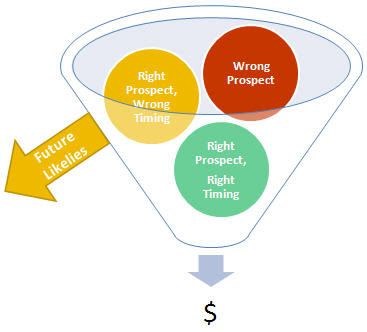
The solution to this problem is in differentiating between a "good prospect" and a "good prospect who's interested". This comes down to looking at inbound interest level and web activity to determine whether it appears that they are the right executive in a buying cycle, or just the right executive.
It is often the case that a large number of your leads, fall into the category of "future likelies". They are the right executive, in the right role, at the right company, but you don't see the activity patterns that indicate buying interest. Nobody benefits by sending future likelies over to sales. Both your sales team and the prospect will be frustrated by a sales call where there is no buying process happening.
Instead, future likelies need to be nurtured (see post on Nurturing here: http://digitalbodylanguage.blogspot.com/2008/12/nurture-marketing-vs-pachinko.html). Provide them with education on the market, your solutions, things that educate them and add value to their day. When a buying event happens (and with good lead scoring, you will see the signs of that buying event), you will be top of mind with them and can then get your sales team involved.
http://www.crmbuyer.com/story/Is-the-Ship-Really-Sinking-B2B-Budgeting-for-Post-Slump-Growth-65547.html. In it, there's a stat that very few of us in B2B marketing will find surprising:
"Aberdeen research that suggested that upwards of 60 percent to 70 percent of
leads are never followed up by sales."
This is a horrific number when you consider the investments being made in order to generate these leads. Sales is commission-driven, so if they are not following up with your leads, it's likely because the leads are not turning into revenue for them.
In most cases, the problem is not that the leads being passed over to sales are inherently bad leads, in many cases they may be executives, in the right role, at companies of the right size in the right industries. The problem is that they are not currently in a buying process, and therefore are not interested in interacting with your sales team at the moment. If you've been sending this type of lead to sales for a while, it won't be a surprise to see that they don't follow up with the leads they receive.

The solution to this problem is in differentiating between a "good prospect" and a "good prospect who's interested". This comes down to looking at inbound interest level and web activity to determine whether it appears that they are the right executive in a buying cycle, or just the right executive.
It is often the case that a large number of your leads, fall into the category of "future likelies". They are the right executive, in the right role, at the right company, but you don't see the activity patterns that indicate buying interest. Nobody benefits by sending future likelies over to sales. Both your sales team and the prospect will be frustrated by a sales call where there is no buying process happening.
Instead, future likelies need to be nurtured (see post on Nurturing here: http://digitalbodylanguage.blogspot.com/2008/12/nurture-marketing-vs-pachinko.html). Provide them with education on the market, your solutions, things that educate them and add value to their day. When a buying event happens (and with good lead scoring, you will see the signs of that buying event), you will be top of mind with them and can then get your sales team involved.
|
|
|
||||||
|
Subscribe to:
Posts (Atom)


