Friday, September 11, 2009

Marketing Automation Weekly Wrap-up - 2009/09/11


In this week's marketing automation weekly wrap-up, there seems to be a theme of "lists" as lists are published, and list nominations are called for. At the same time, some recent listings of great B2B and Marketing Automation related blogs have surfaced some great writers I did not have on my own reading list previously.

Galen De Young (@GalenDY) from Proteus B2B Marketing published the 2009 list of B2B marketing blogs, many of which are classics, and many were new to me. It’s a tremendous (and comprehensive) list, and I was able to add a few new ones to my own list of blogs to read:

http://www.proteusb2b.com/b2b-marketing-blog/index.php/big-list-b2b-marketing-blogs/


The B2B Marketing Zone is also worth introducing, on our theme of "lists", for those who haven't come across it yet. Managed by Tom Pick and Tony Karrer, it aggregates many of the best B2B marketing blogs, and provides their content in an easily accessible way:

http://www.b2bmarketingzone.com/


Kate Brodock (@just_kate) from B2B Voices makes a push for video as a key part of the B2B marketer’s tool kit, if nothing else, because of its SEO effects. I like the fact that Kate avoids the idea that B2B videos must “go viral” to be successful:

http://www.b2bvoices.com/2009/09/using-video-as-a-b2b-marketing-tool/


Susan Fantle on B2B Marketing Smarts looks at resurrecting the dead with a discussion of the merits of direct mail in a B2B environment. It’s definitely a media type that has been under-utilized recently and has some compelling benefits:

http://b2bmarketingsmarts.com/?p=393


Stuart Wheldon on B2B Magazine with a post about SaaS, Social Media, and the economics of educating buyers. Makes for an interesting read in looking at the economic reasons behind why we are more apt to invest in buyer education than ever before:

http://www.b2bm.biz/blog/2009/09/saas-social-media-and-the-econ.html


Simon Salt (@incslinger) from Inc Slingers provides an Essential Social Media bookshelf of must-reads for social media, and it’s not the list you might expect as he goes beyond pure social media titles. (note: I’m biased here, as Digital Body Language was included – thanks Simon!):

http://www.theincslingers.com/2009/09/the-essential-social-media-bookshelf/


James Obermayer from the Sales Lead Management Association continues the theme of “lists” this week as he has opened nominations for the 50 most influential lead management professionals list:

http://blog.salesleadmgmtassn.com/2009/09/01/slma-seeks-nominations-for-first-annual-50-most-influential-sales-lead-management-professionals-list.aspx


Craig Rosenburg (@funnelholic) from The Funnelholic looks at webinars and what makes them work, with his recent post on the ABC’s of highly converting webinars:

http://www.funnelholic.com/2009/09/03/the-abcs-of-highly-converting-webinars/


Tim Wilson (@tgwilson) from Gilligan On Data covers data, business, math, and the irrational quirks of human psychology in this post on data cleansing processes – worth a read for anyone wondering why data always seems to be a mess:

http://www.gilliganondata.com/index.php/2009/09/04/the-inertia-of-the-status-quo/


Kipp Bodnar (@kbodnar32) from Social Media B2B looks at 3 examples of B2B companies using Facebook as part of their marketing efforts. Lots of experimentation in this area, but it’s hard to see the ideal path. Kipp’s examples are interesting success stories:

http://socialmediab2b.com/2009/09/b2b-company-facebook-lead-generation/


I hope you enjoyed this week's writings on marketing automation and B2B marketing as much as I did. It's great to have a new set of writers to keep track of.
BOOK
Many of the topics on this blog are discussed in more detail in my book Digital Body Language
SOFTWARE
In my day job, I am with Eloqua, the marketing automation software used by the worlds best marketers
EVENTS
Come talk with me or one of my colleagues at a live event, or join in on a webinar

Thursday, September 10, 2009

Renewal Marketing and Social CRM


Much of our discussion to date on this blog has focused around the new purchase scenario. However, in today’s world, the focus on existing business is often equally or more important. I’m not even referring specifically to the economic climate, although that enhances the focus. I’m referring to the general shift towards both a market-controlled reputation through social media, and a shift towards recurring revenue models in many industries.

As social media gives everyone in the market a voice, brand reputation becomes more and more in the control of the market. This reputation guides future purchase decisions of your prospective buyers, as it is usually both more prevalent and more trusted than the messages that your own marketing department can communicate.

As I’ve worked with clients in many industries, there is an increasing emphasis placed on marketing communications that target existing customers. The motivators vary from industry to industry, but regardless of whether it is an information subscription in the publishing industry, or a software purchase from a Software-as-a-Service (SaaS) vendor, the general reasons are as follows:

- Initial Engagement: Get the customer initially engaged in the product, and up the deployment/first use curve as quickly as possible in order to maintain the momentum of their initial purchase and ensure that successful usage of the service takes place.

- Success/Depth: Engage the customer in progressively deeper and more advanced capabilities or usage patterns in order to ensure they are receiving (and recognizing) maximum value from the service.

- Stickiness: Drive adoption patterns within an organization, or integration points within a set of corporate systems that both add value and increase “stickiness” on renewal by making the solution a more integral part of the business.

- Community: Introduce the customer to other customers in the community to share experiences, ideas, and best practices, both with each other, and also back to the vendor in order to enhance understanding of where the solution needs to evolve towards.

The marketing communications to drive customers through these phases of success are one element, but likewise, so is the Social CRM platforms that allow the customer community to interact with each other, and with you.

Next week (Tuesday, September 15th, 1 EST), I’m honored to be on a panel to discuss the evolution of Social CRM with none other than Geoffrey Moore from the Chasm Group. In a panel put together by Helpstream, I’ll discuss the evolution of Social CRM, and whether it has crossed the chasm to the mainstream with Treb Ryan, CEO of OpSource, and Brent Potts, Vice President of Hewlett-Packard:

http://info.helpstream.biz/Crossing-the-Chasm-to-Social-CRM.html

I hope you can join me as it should prove to be a very interesting discussion.
BOOK
Many of the topics on this blog are discussed in more detail in my book Digital Body Language
SOFTWARE
In my day job, I am with Eloqua, the marketing automation software used by the worlds best marketers
EVENTS
Come talk with me or one of my colleagues at a live event, or join in on a webinar

Tuesday, September 8, 2009

Relationship Sales and Today's New Buyer


For years, the prevailing thinking in sales has been oriented around relationship sales. The idea was that by being a friendly person, a good listener, and a decent golfer, you could gain the opportunity to build trust with potential buyers. In initial conversations, sales would ask a lot of questions, learn about the prospect’s business, delve deep into areas of pain or business challenge, and finally wrap things up with a solution that was oriented to curing these pains and solving these challenges.

However in today’s world, there is often not an opportunity to have that conversation in the first place. Unless you have information of value to offer first, the chance of a prospective buyer wanting to spend an hour with you to describe their business while you ask questions is plummeting . The access to information, which was once mainly managed by sales, is now open to all. This has forever changed the dynamics of relationship selling, as the early conversations, upon which the “trusted advisor” relationship were built, are now being diligently avoided by most prospective buyers.

Now, that trust is built by educating prospective buyers early in their buying process, providing information of value to them, and establishing the credibility of knowing enough about the space to be able to solve their problems. Rather than relying on large sales teams with good golf skills, this now relies on marketing and sales teams who are able to work together closely to understand prospective buyers and educate them on topics of interest to them so they remain engaged throughout a lengthy buying cycle.

So where does that leave the discipline of Sales?

The discipline of sales is changing fundamentally, as there is a shift away from the upfront concepts of relationship building social functions and the discovery call. Sales is shifting towards being a discipline that builds trusted relationships based on providing real business value based on prospective buyers true needs and discovery based on guiding, and observing, buyers own education processes.

For those in the Atlanta area, I’m excited to be joining Rick Page, author of Hope is Not a Strategy, and Debbie Qaqish, Principal Partner at the Pedowitz Group in a luncheon and panel discussion on these exact topics. The event is on Friday, September 25th, and more information is available here:

http://success.eloqua.com/?elqPURLPage=2557

For those unable to attend this event in Atlanta, I will definitely share the ideas, thoughts, and discussions that come out of the event with the audience here.


BOOK
Many of the topics on this blog are discussed in more detail in my book Digital Body Language
SOFTWARE
In my day job, I am with Eloqua, the marketing automation software used by the worlds best marketers
EVENTS
Come talk with me or one of my colleagues at a live event, or join in on a webinar

Friday, September 4, 2009

Best Practices for Webinars and Online Events


Online events, such as webinars, are one of the top techniques used by B2B marketers focused on demand generation. The reasons are clear:

  • they are effective at generating interest and attendance
  • they are not expensive, compared to in-person events or tradeshows
  • a recorded webinar can be re-used as a content asset for many months
  • thought leadership can be established through events that feature in-house or industry experts
  • prospects appreciate the ability to attend from their desk and drop off if the content is not of interest

However, there is a difference between doing online events, and doing them well. In this video, Rhonda Wunderlin discusses the best practices for promoting the event, minimizing the registrant/attendee drop-off rate, and maximizing the effectiveness through great follow-up.


(if this does not load, please click here for the best practices for webinars and online events video)

Online events and webinars are great for lead nurturing, as they are generally non-salesy, and thus more appropriate in the early stages of a buying process. Registration and attendance also for key indicators of interest and are often used as components of lead scoring programs.
BOOK
Many of the topics on this blog are discussed in more detail in my book Digital Body Language
SOFTWARE
In my day job, I am with Eloqua, the marketing automation software used by the worlds best marketers
EVENTS
Come talk with me or one of my colleagues at a live event, or join in on a webinar

Wednesday, September 2, 2009

Marketing Dashboards


The old adage of “you can’t manage what you can’t measure” is as true in marketing as in any other discipline, but in marketing there is often a challenge of defining what one wants to measure. Especially in B2B marketing, the length of the buying process leads to challenges in defining metrics that make sense for a marketing dashboard. Some metrics may seem too transient, being only relevant to a particular campaign. Some metrics may seem too tactical, not strategic enough to the business. Still further, some metrics may seem too difficult to achieve, requiring a broad change in processes before the metrics are possible.

This challenge leaves many CMOs, VPs, and Directors of Marketing without the same level of dashboard metrics that their peers in other functions rely up on to run their businesses.

However, there are a number of key areas of B2B marketing that can be greatly enhanced with dashboards with today’s capabilities. Here are a few key areas to think about as you build critical management metrics for your marketing organization:

Funnel Management:
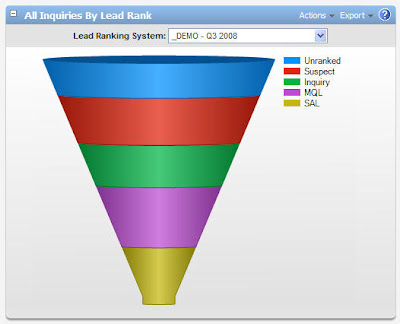
As we adapt to today’s buying processes where the buyers are in control, we need to adapt our thinking on how we look at a marketing funnel. Buyers progress through their own buying process at a pace that is controlled by them, and the best way to measure it is to use a top-down marketing analysis structure. First, an understanding of digital body language allows us to determine where in their buying process each person is. From there, we can measure the marketing funnel using a balance sheet and income statement metaphor.

The balance sheet view gives us a snapshot of the current state of the marketing funnel. How many suspects, inquiries, and MQLs, are in the marketing funnel at that moment in time. The income statement view gives us an understanding of how the funnel has changed in the last quarter as leads move up, down, into, or out of the funnel.

These top-down views of the performance of a marketing organization allow a high level understanding of what the health of the overall organization looks like. If there are too few leads in one part of the funnel, it indicates a future challenge in revenue generation. A strong motion in the funnel in one quarter can indicate a highly successful marketing push to move buyers through certain stages of their buying process. As these views do not change with time, they are excellent high level dashboards for a CMO or VP of Marketing.


Communication and Response
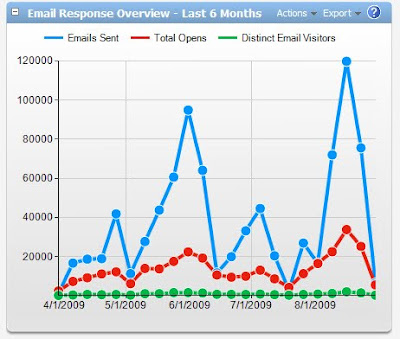
Communication of messages is a key role of any marketing organization, and most do so with the goal of generating a response. As an executive in charge of a marketing organization, it is important to remain aware of the pulse of messaging and response with your marketing organization. First, a high level view of your email campaign history is key; how many campaigns have been sent and how many recipients were communicated with. Seeing this communication pattern over time allows you to understand if there are spikes or lulls in your communication pattern. Another key view of your outbound communications would show your email frequency – how many times you are communicating to each person in your database – to indicate if you are having any over or under-communication challenges.

Response, is also critical to measure. In terms of web traffic, new and repeat visitors are important to understand as they give you a view into trends of potential buyers visiting your website. Likewise, inquiry counts (submission of web forms), give you an understanding of the number of individuals engaged with your marketing offers. If you are making any search or social media investments, a measurement of the raw traffic being generated by source is also critical to understanding the success in each of these areas.

The patterns in your outbound communication and response patterns are ideal for dashboarding, as they are each views that do not change over time, but provide very valuable insight into the trends, challenges, and successes you are facing.


Database Growth and Data Quality
A marketing organization focused on demand generation is only as good as the marketing database it is nurturing. To do this successfully, the database growth and quality must be carefully managed. That means that dashboards of database growth and data quality are key in understanding trends, problems, and opportunities.

There are a few factors involved in database growth, each of which can be easily monitored and managed through dashboards. Raw growth through net new names, and tempered by unsubscribes and hard bounce-backs is a key component of any marketing dashboard. On top of that, however, monitoring the growth and relative size of your inactive segment gives you an understanding of those who are on the path to being emotionally unsubscribed, essentially becoming an inaccessible part of your database.

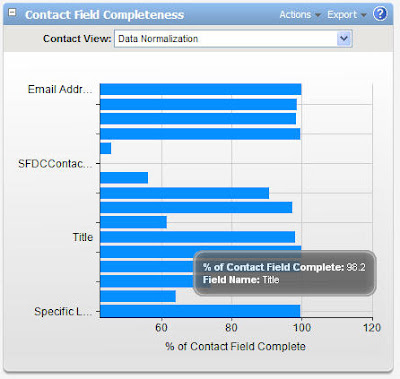
Data quality has many aspects that are deeper than a top-level dashboard allows, but a few key aspects of data quality can still be measured effectively. Data completeness is one such aspect. For the 10 or 20 fields in your database that you are most concerned about, a dashboard showing data completeness allows you to quickly understand your progress towards ensuring that these fields are completed by the majority of your marketing audience.

Sales Alignment and Adoption

A successful B2B marketing organization needs to focus as much on enabling the sales team they serve as on their own marketing activities. Even more so in this case than in others, the use of marketing dashboards is crucial in understanding how successful they are being with enabling the sales team. As content is provided to the sales team to use in their communications, a dashboard should be set up to provide insight into which content assets are being used, and which members of the sales team are most active. Similarly as lead nurturing programs are provided to sales as disposition options, a marketing dashboard should show which nurture programs are being used.

Similarly, when leads are passed to sales, if a service level agreement has been reached with sales beforehand, a dashboard can be very useful in monitoring and measuring how quickly qualified leads are followed up on, and whether these timelines are sufficient.


Dashboards on Marketing Assets
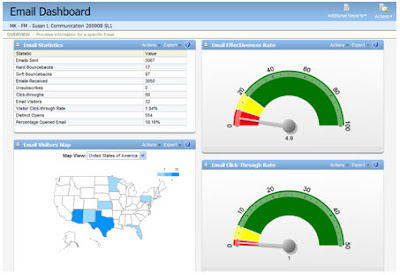
So far, we’ve mainly discussed top-level marketing dashboards that provide a glimpse into the performance of an overall B2B marketing organization. However, of equal importance are the dashboards on individual marketing assets. For example, when an email campaign is launched, a landing page is posted, a web form created, or a search campaign initiated, being able to quickly run a dashboard of critical metrics on that marketing initiative is important to building a culture of marketing analytics.

With dashboards on individual assets available quickly and easily, each tactic that is used can be analyzed, understood, and compared against similar assets to understand its performance in context. This culture of analysis quickly weeds out underperforming campaigns by focusing management attention on the metrics that determine their success.

Dashboards as a B2B Marketing Tool

Whereas other functions have leveraged dashboards successfully for many years, marketing has historically been without the ability to devise effective, relevant dashboards that allowed CMOs, VPs, and Directors of Marketing to understand and manage their businesses. Now, with the transition in today’s buyer to be more in control of their own buying process, while also being much more online, marketing dashboards are both possible and necessary.
BOOK
Many of the topics on this blog are discussed in more detail in my book Digital Body Language
SOFTWARE
In my day job, I am with Eloqua, the marketing automation software used by the worlds best marketers
EVENTS
Come talk with me or one of my colleagues at a live event, or join in on a webinar